
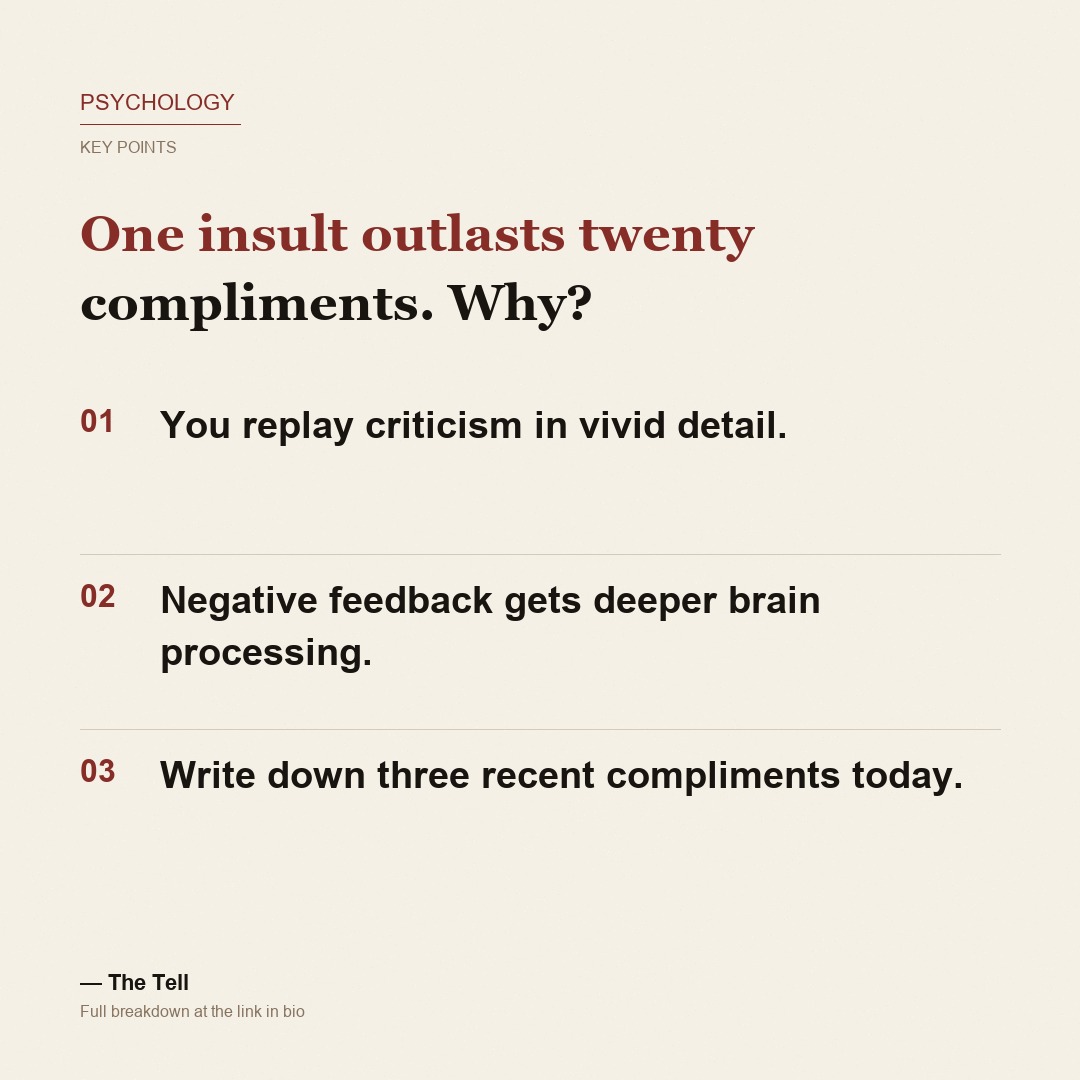
Your brain is not designed to be fair. It remembers the one critical comment in a sea of praise, replays the insult from three years ago, and forgets last week’s genuine compliment by Tuesday.
You’re leaving a performance review. Your manager spent twenty minutes praising your work—your initiative, your collaboration, the project you delivered early. Then, in the last sixty seconds, she mentioned one area for improvement: “Sometimes your emails could be a bit more concise.” You nod, say thank you, and leave the room. That night, lying in bed, which part of the conversation loops in your head? Not the twenty minutes of praise. The sixty seconds of critique.
This isn’t weakness. It’s wiring.
Why Do People Remember Insults Better Than Compliments? Negativity Bias
Psychologist Roy Baumeister and his colleagues published a landmark review in 2001 titled “Bad Is Stronger Than Good.” They synthesized decades of research across relationships, learning, memory, and emotion. The conclusion: negative events, negative emotions, and negative feedback have a stronger and more lasting impact on our psychological state than neutral or positive ones. The ratio isn’t even close. Some researchers estimate it takes roughly five positive interactions to counterbalance one negative one in close relationships.
Why? Evolutionary pressure. Your ancestors who ignored the rustling bush (potential threat) didn’t survive as often as those who overreacted to it. Remembering what hurt you, embarrassed you, or endangered you kept you alive. Remembering a compliment? Nice, but not survival-critical. Your brain still runs that old software, even though the “threats” today are usually social, not physical.
The mechanism is neurological. Negative stimuli generate more neural activity than positive ones, especially in the amygdala—your brain’s alarm system. They’re also encoded more richly in memory. An insult doesn’t just get filed away; it gets wrapped in context, emotion, physical sensation, and rumination. A compliment often breezes past with a smile and a “thanks.”
1. Negative Feedback Lands Harder and Stays Longer
The signal: You replay criticism in vivid detail—the words, the tone, even the room—but struggle to recall specific compliments from the same week.
Why it happens: Your brain tags negative information as “important.” It gets more processing power, more emotional weight, and deeper encoding. Compliments often feel good in the moment but don’t trigger the same alarm bells, so they’re stored more lightly.
How to use it: When giving feedback, lead with genuine positives and be ultra-specific. Vague praise (“good job”) fades fast. Concrete praise (“your opening slide nailed the client’s concern in ten seconds”) has more weight. And if you must deliver criticism, acknowledge the negativity bias out loud: “I know critical feedback sticks more than praise, so I want to be clear—this is one small thing in a much larger picture of solid work.”
2. Insults Trigger Rumination Loops
The signal: You mentally replay an insult or awkward moment over and over, each time finding new angles to feel worse about it.
Why it happens: Rumination is your brain’s (flawed) attempt to solve a social threat. It thinks if you analyze the insult enough, you’ll figure out how to prevent future pain. But rumination rarely leads to insight—it just deepens the groove of the memory.
How to use it: When you catch yourself looping, name it: “I’m ruminating.” Then redirect with one concrete question: “What’s one thing I can actually do about this?” If the answer is “nothing” or “it’s already resolved,” the loop is just noise. Let it be noise. You don’t have to believe every thought your brain serves up.
3. You Discount Compliments as Politeness or Exaggeration
The signal: When someone praises you, your immediate internal response is skepticism—”they’re just being nice” or “they didn’t really mean it that way.”
Why it happens: Negativity bias makes criticism feel true and compliments feel suspect. We also live in a culture where polite exaggeration is common (“great to see you!” to an acquaintance you barely know), so your brain discounts positive words as social lubrication, not data.
How to use it: Practice taking compliments at face value, at least for sixty seconds before you discount them. If someone says your presentation was clear, let it be true for a minute. You can always doubt it later. Also, when you give compliments, be hyper-specific. “I really liked your idea” gets discounted. “Your idea about splitting the timeline into two phases solved the exact problem we were stuck on” sticks.
4. Criticism Feels Like Information; Praise Feels Like Noise
The signal: You treat critical feedback as something to study, analyze, and act on. Positive feedback? You smile, move on, and forget it by the afternoon.
Why it happens: Your brain is wired to prioritize “what’s wrong” over “what’s right.” Criticism feels like a map to improvement. Praise feels like confirmation of the status quo, which your brain tags as less urgent.
How to use it: Deliberately log positive feedback. Keep a file, a note, or a folder. When you receive a genuine compliment, write it down verbatim that day. Over time, this creates a countermeasure to negativity bias—a tangible record your brain can’t as easily dismiss. Reread it when the next insult lands harder than it should.
5. Social Pain Activates the Same Brain Regions as Physical Pain
The signal: An insult doesn’t just sting emotionally—it can feel visceral, almost like a punch. Your chest tightens. Your face flushes. The memory of it can make you wince years later.
Why it happens: Neuroscientist Naomi Eisenberger’s research shows that social rejection and exclusion activate the anterior cingulate cortex and the insula—regions involved in processing physical pain. Your brain treats social wounds as real wounds. That’s why “sticks and stones” is terrible advice.
How to use it: When you’re on the giving end of tough feedback, remember: it’s going to hurt more than you think. Don’t sugarcoat dishonestly, but do frontload empathy and context. “This is hard to hear, and I get that” isn’t coddling—it’s acknowledging neuroscience. On the receiving end, remind yourself: the sting is real, but it’s not proportional to the threat. Your brain is overreacting by design.
6. One Negative Interaction Can Outweigh a Week of Positive Ones
The signal: After a string of good days—productive meetings, kind exchanges, smooth collaboration—one tense email or offhand criticism sours your entire mood and memory of the week.
Why it happens: Baumeister’s research shows that negative events dominate our emotional and cognitive landscapes disproportionately. One bad thing isn’t just “one” thing—it colors everything around it. This is especially true in close relationships, where a single fight can overshadow months of affection.
How to use it: If you’re trying to build trust or morale with someone, consistency matters more than grand gestures. Ten small positive interactions buffer against one bad day. And when you do mess up—snap at someone, send a curt email—repair it explicitly. Negativity bias means the other person will remember the rupture vividly. A quick, sincere acknowledgment (“I was short with you earlier—I’m sorry”) helps reset the balance.
7. You Remember the Critic’s Face, but Not the Complimenter’s
The signal: You can picture the person who insulted you three years ago in perfect detail—their expression, their posture, the exact moment. But the person who gave you a thoughtful compliment last month? Their face is already fuzzy.
Why it happens: Negative emotions enhance memory encoding. The brain doesn’t just store the words—it stores the full sensory and emotional context. Positive moments, unless they’re exceptionally intense, don’t get the same red-flag treatment.
How to use it: Consciously anchor positive moments. When someone compliments you, pause for three seconds. Look at them. Let it register. That brief moment of attention can help your brain encode the memory more richly, giving it a fighting chance against the insult you’ll inevitably hear next month.
The Ethical Takeaway: Rebalance the Scale
You can’t rewire negativity bias—it’s older than cities, older than language. But you can work around it. One thing to try today: write down three specific compliments or positive interactions you’ve received recently. Not vague ones—concrete, detailed moments. “She said my intro framed the problem clearly.” “He texted to say the dinner I cooked was the best thing he’d had all week.” Read the list once. That’s it. You’re not trying to feel good. You’re creating a record your brain can’t selectively forget.
And when you give feedback—positive or negative—remember the weight is uneven. Your compliment will need repetition and specificity to stick. Your criticism will land heavy and stay long. Choose both carefully.
For insight and connection — not diagnosis or judgment.
What’s one insult you remember better than ten compliments? Drop it in the comments, or just nod quietly. We’ve all been there.