
The advice sounds reasonable: prepare your elevator pitch, practice it until it’s smooth, deliver it with confidence. But here’s the problem — the more rehearsed you sound, the less people trust you.
You’re at a networking event. Someone asks what you do. You launch into your polished 30-second intro — the one you practiced in the mirror — and you can see it in their eyes: they’re already planning their exit. Not because your pitch was bad. Because it sounded like a pitch.
Nalini Ambady’s thin-slice research at Harvard showed that people form surprisingly accurate impressions in under 10 seconds, often from nonverbal cues alone. When your words sound scripted, your body language goes flat. The mismatch registers as inauthentic, even if everything you’re saying is true. At networking events, where everyone’s radar is tuned for sales-speak and self-promotion, that mismatch kills the connection before it starts.
The goal isn’t to wing it completely. It’s to sound like a person, not a press release. Here’s what actually separates introductions that land from ones that fall flat.
How to Introduce Yourself at Networking Events Without Sounding Rehearsed
The difference isn’t what you say. It’s how your brain is working while you say it. When you recite from memory, you’re retrieving. When you talk like a human, you’re constructing in real time — and people can tell.
1. Start With Them, Not You
The signal: People who open with a question or observation about the other person come across as more engaged, even if they eventually talk about themselves for the same amount of time.
Why it happens: When you start with “So what brought you here tonight?” or “I saw your comment in the Q&A — that was sharp,” your brain shifts into conversation mode instead of broadcast mode. Your vocal tone loosens. Your face moves. You sound like someone talking, not performing.
How to use it: Open with genuine curiosity about the other person. Not as a tactic — as an actual interest. Notice something specific (their question during the panel, the company name on their badge, the fact that they’re standing alone like you are) and start there. You’ll get to your intro, but it’ll feel like part of a dialogue.
2. Let Your Sentence Structure Vary
The signal: Rehearsed speakers use the same sentence rhythm over and over. Natural speakers vary — short punch, longer explanation, fragment, question.
Why it happens: When you memorize, you lock in syntax. When you construct on the fly, your sentences follow your thinking, which is rarely uniform. That variation signals that you’re present, not playing back a recording.
How to use it: Don’t script full sentences. Script anchor points instead: “I help companies figure out why their teams aren’t shipping” or “I research how people make snap decisions.” Then build around those in the moment. The surrounding sentences will be different every time — and that’s the point.
3. Use Conversational Filler (Sparingly)
The signal: A tiny “um,” a brief pause to think, a mid-sentence course correction — these make you sound human. Zero filler makes you sound like you’re reading.
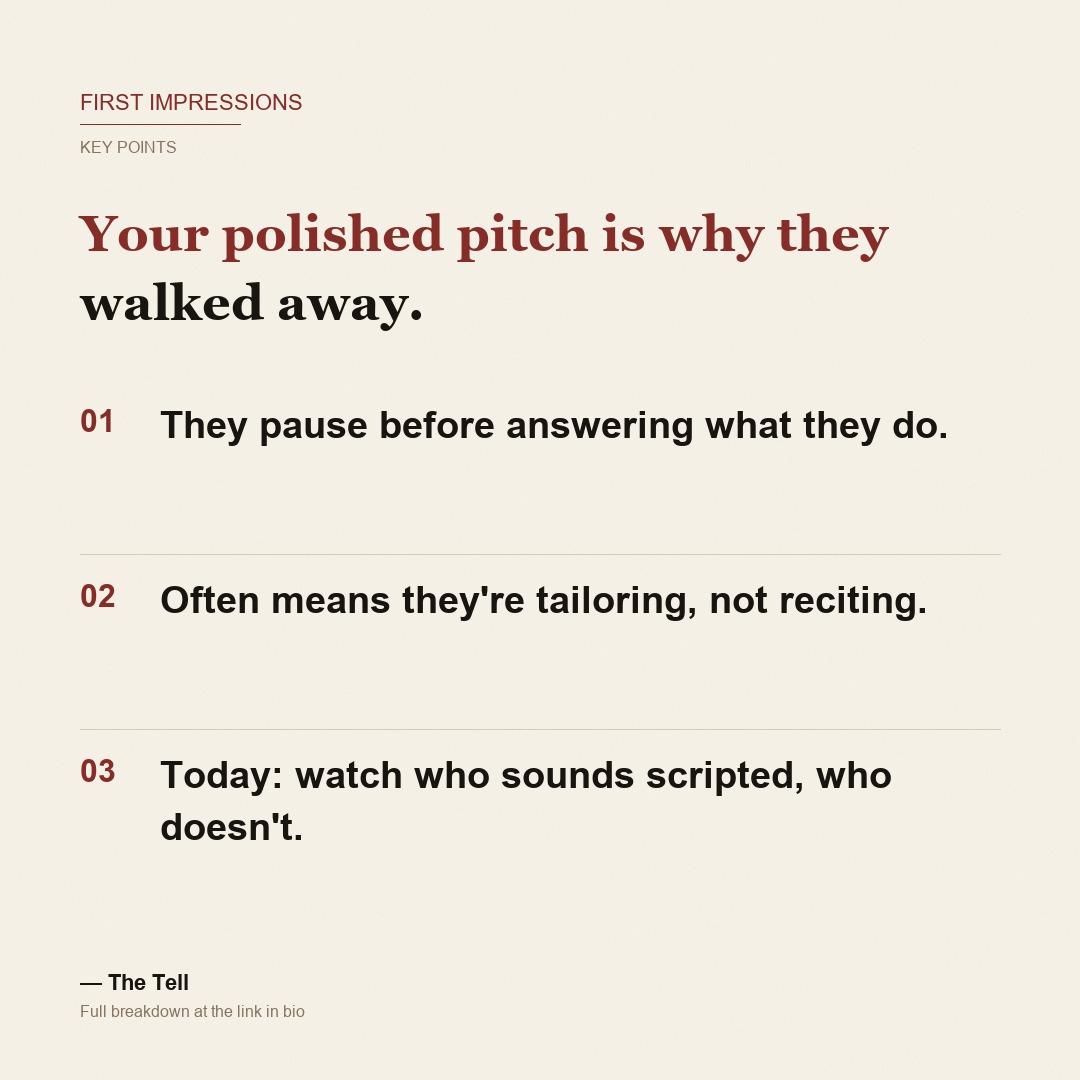
Why it happens: Real-time thinking has texture. Retrieval is smooth. When someone asks what you do and you answer instantly with zero hesitation, it doesn’t sound confident — it sounds preloaded. A beat of thought before you respond signals that you’re tailoring your answer to them, not serving the same plate to everyone.
How to use it: Don’t artificially inject “um” or “you know.” But don’t hunt them down and kill them, either. If you pause for half a second to shape your phrasing, that’s fine. It reads as thoughtfulness, not uncertainty.
4. Match Their Energy, Not Your Script
The signal: People who adjust their pace and volume to the person in front of them feel easier to talk to. People who deliver at one speed regardless of context feel like they’re on autopilot.
Why it happens: Matching is a natural rapport signal. When you stick to your memorized cadence no matter what, you break the feedback loop. The other person feels like they’re listening to a monologue, not having a conversation.
How to use it: Pay attention to how they’re talking. If they’re quick and sharp, tighten up. If they’re slower and more thoughtful, give your sentences room. This doesn’t mean mimic them — it means let them influence your rhythm. That’s what happens in real conversations.
5. End With a Question, Not a Period
The signal: Introductions that land with a question (“What about you — what kind of projects are you working on?”) feel like openings. Ones that end with a statement feel like closings.
Why it happens: A question is an invitation. It shifts the conversational weight back to them and signals that you’re interested in dialogue, not airtime. Even if you’ve just spent 20 seconds talking about yourself, ending with a question reframes the whole exchange.
How to use it: Don’t ask a generic question. Tie it to something they said or something you noticed. “You mentioned you’re in product — are you on the building side or the strategy side?” works because it’s specific. “So what do you do?” after you’ve just monologued doesn’t.
6. Let Your Face Move
The signal: When people rehearse, they focus on words. Their facial expressions flatten or lock into one default (usually a nervous smile). Natural speakers’ faces shift — slight eyebrow raise, a quick grin, a moment of seriousness.
Why it happens: Expressions follow meaning when you’re constructing sentences in real time. When you’re retrieving a script, your face idles. That disconnect — animated words, static face — is one of the fastest ways to trigger the “this person is performing” alarm.
How to use it: You can’t fake this by deciding to move your face more. But you can create the conditions for it: talk about something you actually care about, in words you’re choosing right now, to a specific person in front of you. Your face will follow.
7. Drop the Closer
The signal: Rehearsed intros often end with a tagline or a call to action (“…so if you ever need help with X, I’m your guy!”). It lands like a sales pitch, because it is one.
Why it happens: Networking advice tells you to “always be closing.” But in a first conversation, closing feels presumptuous. People want to know if they like you before they think about working with you.
How to use it: Just… don’t close. Introduce yourself, show genuine interest in them, and let the conversation go where it goes. If there’s a fit, it’ll surface naturally. If you try to force it in the first 60 seconds, you’ve already lost them.
Read to Connect
The best introductions don’t sound like introductions. They sound like the beginning of a conversation with someone who’s actually interested. That doesn’t happen when you’re focused on delivering your lines. It happens when you’re focused on the person in front of you.
Try this today: Next time someone asks what you do, pause for one real second before you answer. Not a dramatic pause — just a breath. Then answer in a sentence you’ve never said exactly that way before. Notice what happens to your face, your rhythm, and their eyes.
For insight and connection — not diagnosis or judgment.
What’s your go-to networking move — or the one that never works? Drop it in the comments.